What happens when organizations ritualize “good process” but the outcomes never show up? The stand-ups happen. The sprint cadence holds. The boards look tidy. The business impact... well that stays flat.
You get Process Theater.
I didn't invent the term. But I want to call it out plainly because I've seen it over and over again in project management scenarios. Even from prestigious institutions that purport to value sound principles in Project Management. Managers spend more time meeting than they do engaging. Various reports are produced that end up collecting names on the email chain, but are never discussed. Backlogs grow, but the customer never sees any meaningful change.
When it exists the result is the business needs are deprioritized in favor of reporting, governance, and metrics. You then get businesses that spend millions of dollars of their budget on flow charts, but fail to meet their output needs in order to keep the doors open. The process itself isn't bad. But the corporate silos have become so much a part of culture that the process has become the job. People have stopped working towards a collective goal, and instead are focused on individual controlled outputs.
Make no mistake: This is a company cultural problem. And it can happen to a company of any size.
Scrum.org’s Yuval Yeret describes it plainly: teams are busy “doing Agile” or writing OKRs, but results don’t materialize because the organization jumps from “we ran the process” to “we got the outcome” and skips the middle step: the behaviour change and decision-making that actually produces impact (Yeret, 2025).
In product organisations, SVPG calls the broader version transformation theater: the vocabulary and surface signals look modern, but the underlying system still behaves like the old model, which creates frustration and weak outcomes (Hickman & Cagan, 2024).
Different labels. Same disease: performance replaces delivery.
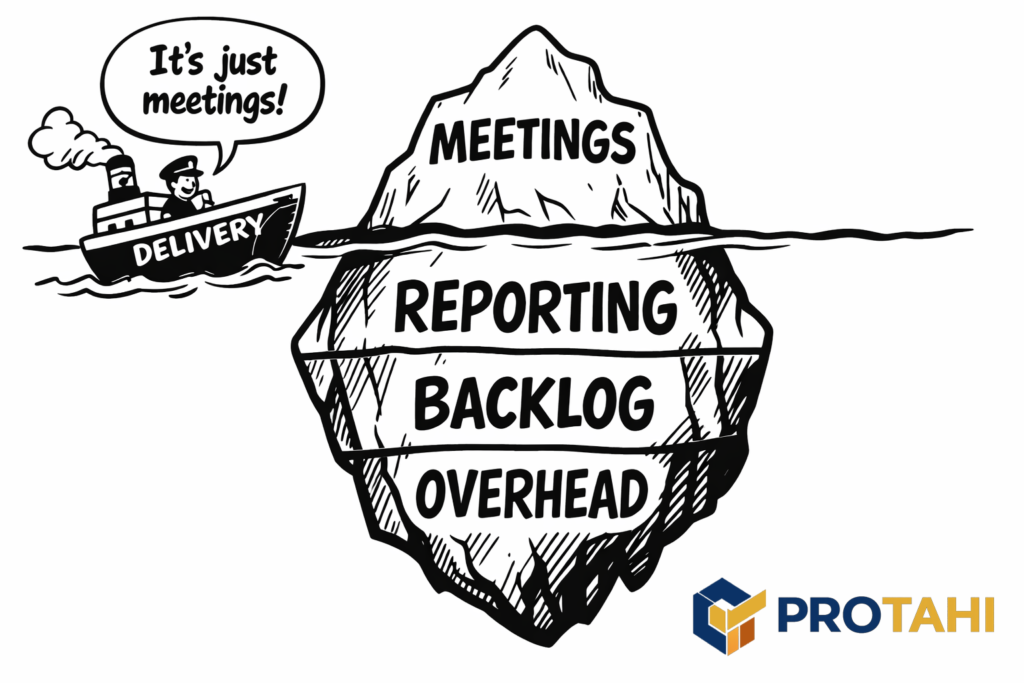
Why Process Theater Happens
Process Theater usually emerges from incentives, not ignorance.
- Governance gets confused with control.
Leaders want predictability, so they demand visibility. Visibility turns into more templates, more status, more ceremony. - Rituals are easier than accountability.
A ritual can be scheduled. Accountability requires someone to own trade-offs, risk, and outcomes. - Metrics drift from outcomes to activity.
If teams are measured on throughput signals, they’ll optimise those signals. You get motion, not progress. - People fear being wrong more than being slow.
When blame is the dominant currency, teams perform compliance. It’s safer than telling the truth.
It's Not Discipline, It's Cost
The cost isn’t just time. It’s decision latency, quality decay, and morale loss.
Badly run meetings and meeting-heavy environments have well-documented links to wasted time and reduced productivity, even outside Agile contexts (Gaborov et al., 2024). Process Theater institutionalizes that waste, then calls it “discipline.”
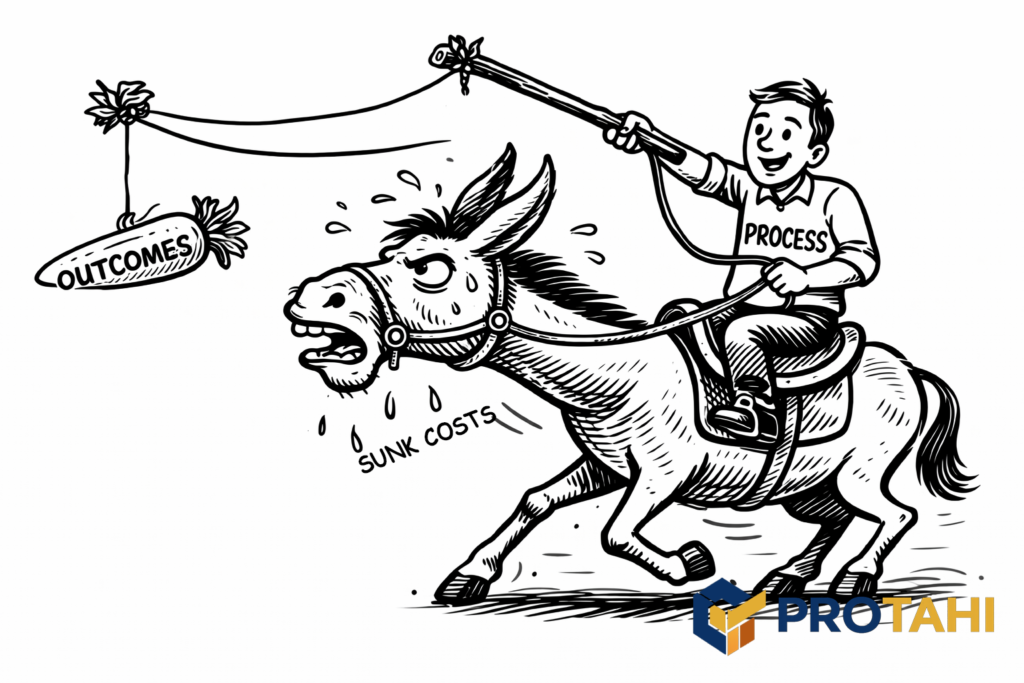
The hidden cost is worse: you train the organization to treat presentation as success. That corrodes engineering standards and makes real improvement politically harder.
Start with the spreadsheet trap. TechCrunch summarizes the state of play bluntly: organisations spend millions on finance software and AI driven change, then still close books and reconcile for audit in Excel (Singh, 2025). At enterprise scale, the spend is worse: ERP overhauls commonly run into the tens of millions, with individual modules in the millions (Overdorff, 2025). Yet spreadsheets remain the default automation layer. A 2024 report write-up citing Rossum's survey found 58% of finance leaders still use spreadsheets as their primary automation tool, and 26% report using no automation tools at all (The CFO, 2024).
Then there's the meeting layer that props it all up. Atlassian's 2024 findings report 72% of meetings are ineffective, and 67% of employees say meeting volume blocks them from doing their best work (Atlassian, 2024). Process Theater institutionalizes this waste, then calls it "discipline." The organization learns to treat presentation as progress, and that makes real improvement politically harder.
Cutting Through the Optics
Ask three questions after any ceremony, dashboard, or transformation artifact:
If the answer is fuzzy, you’re looking at theater.
- What changed in how work gets done, and
- What measurable outcome should move because of it?
- Who is responsible if this fails?
Yeret’s framing is useful here: Process Theater shows up when the “middle step” is missing, when the organization can’t explain how the process creates impact (Yeret, 2025). I'm going one step further with this though. Creating impact is not enough. If there's no accountability chain and failure plan, impact itself becomes theater.
Process Free Isn't the Answer
You don’t fix theater by ripping out structure. You fix it by making structure earn its place.
- Tie process to outcomes, not to compliance.
If a ritual doesn’t produce decisions or reduce customer pain, cut it or redesign it (Yeret, 2025). - Shrink the reporting surface.
Fewer measures, tighter definitions, higher integrity. Activity metrics are easy to game. Outcome metrics are harder, which is why they matter. - Make ownership unavoidable.
Every queue has an owner. Every decision has a named decision-maker. “The team” isn’t accountable. People are. - Move review from theater to inspection.
Reviews should expose reality: what shipped, what failed, what changed, and what the next decision is. If it’s a demo for applause, it’s theater.
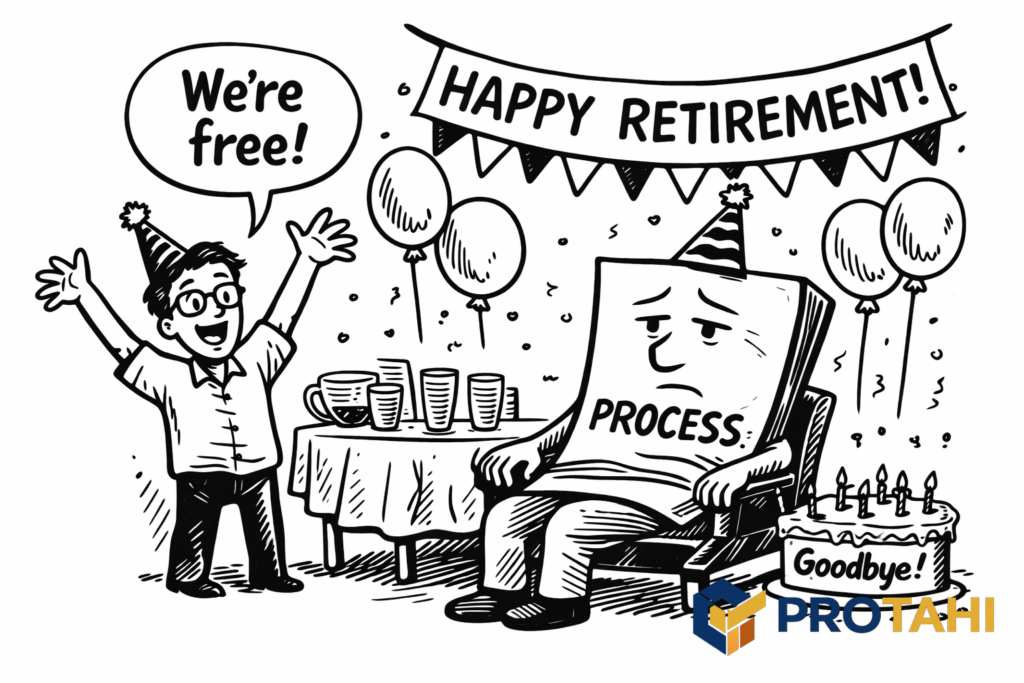
SVPG’s “transformation theater” critique lands here: if the organization changes language but not how decisions are made, it won’t get better outcomes (Hickman & Cagan, 2024). That’s a management problem. It doesn’t get fixed with another framework. It gets fixed when someone is willing to name what’s actually happening.
That’s where an outsider earns their keep. A capable consultant or fractional executive is engaged to deliver a specific outcome, not to protect internal comfort. With real autonomy and clear accountability, they can challenge decision bottlenecks, expose incentive problems, and reset expectations without being captured by the organization’s need for long-term harmony.
How Protahi Can Help
Protahi doesn’t sell ceremonies. If you want pomp and circumstance, talk to someone else. Protahi sells delivery. We tell it to you straight, and we have more than a decade of experience cutting through corporate noise.
The difference is an operator posture. I start with the customer and service outcomes, map the workflow that produces them, then apply the minimum process required to make that workflow reliable.
If the process doesn’t change what happens in production, it isn’t maturity. It’s overhead. Cut it.
If you can’t state a rational purpose and a measurable outcome, it’s bloat. Simplify it.
If the only justification is “we’ve always done it this way,” it’s inertia dressed up as policy. Remove it.
That’s why Protahi’s work leans on talking to real people. We use that to inform more abstract values like service metrics (time to resolution, escalation quality, cost-to-serve, operational risk) and accountability structures. This is weighted alongside framework purity, creating a meaningful result for the organization that puts process where it needs to be: as an aid to success.
Process is useful when it makes reality easier to manage. It’s theater when it’s used to avoid reality.