Fractional Leadership
When hiring a full-time exec is too slow, too expensive, or just the wrong commitment, fractional leadership fills the gap with real decision-making and delivery accountability. It’s becoming a standard move beyond startups as organisations value flexibility under tighter constraints (Harvard Business Review, 2024; MBO Partners, 2025; Wheeler, 2025).
Protahi steps in as an operator, not a “strategy deck” vendor. I founded Protahi to align teams, rebuild service delivery where it’s leaking, and put clean operating rhythm around the work. Prioritizing escalation paths and predictable execution, I build confident teams and robust delivery. My background spans regulated and high-stakes environments across healthtech, emergency communications, and operations-heavy delivery contexts.

Case Studies



No sales deck. Just scope and next steps.
Your content goes here. Edit or remove this text inline or in the module Content settings. You can also style every aspect of this content in the module Design settings and even apply custom CSS to this text in the module Advanced settings.
Service Design
Most “bad service” isn’t bad people. It’s bad design: unclear ownership, dead-end channels, repeat explanations, and handoffs that dump work back on the customer. The loyalty lever isn’t over-the-top delight. It’s making it easy to get a problem solved fast. (Dixon, Freeman, & Toman, 2010).
I design customer service as a system: journeys, queues, automation with clarity, escalation rules, knowledge, and cross-functional checks and balances that aggressively reduce repeated contact and streamline mission critical, 24-hour support delivery. The goal is simple: fewer calls, faster resolution, clear accountability, and customers who feel respected.
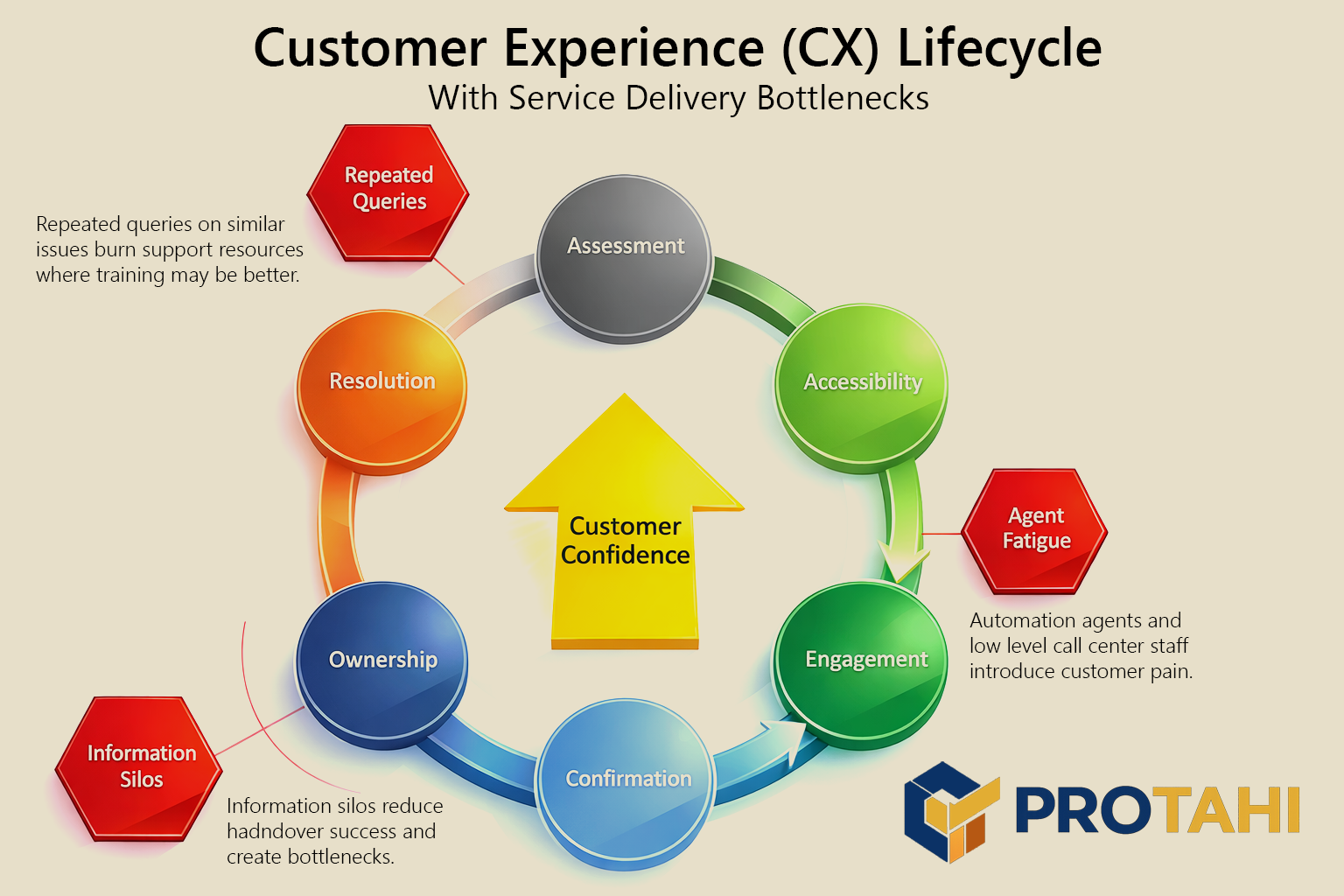
- Lower customer effort: fewer steps, fewer repeats, fewer transfers. (Dixon et al., 2010).
- Higher effectiveness and ease: the two metrics most organisations are currently failing to hold steady. (Forrester, 2024).
- A real service operating model: roles, decision rights, SLAs, KPIs, and escalation paths that work across functions (McKinsey, 2024; Gartner, 2025).
Artificial Intelligence Implementation
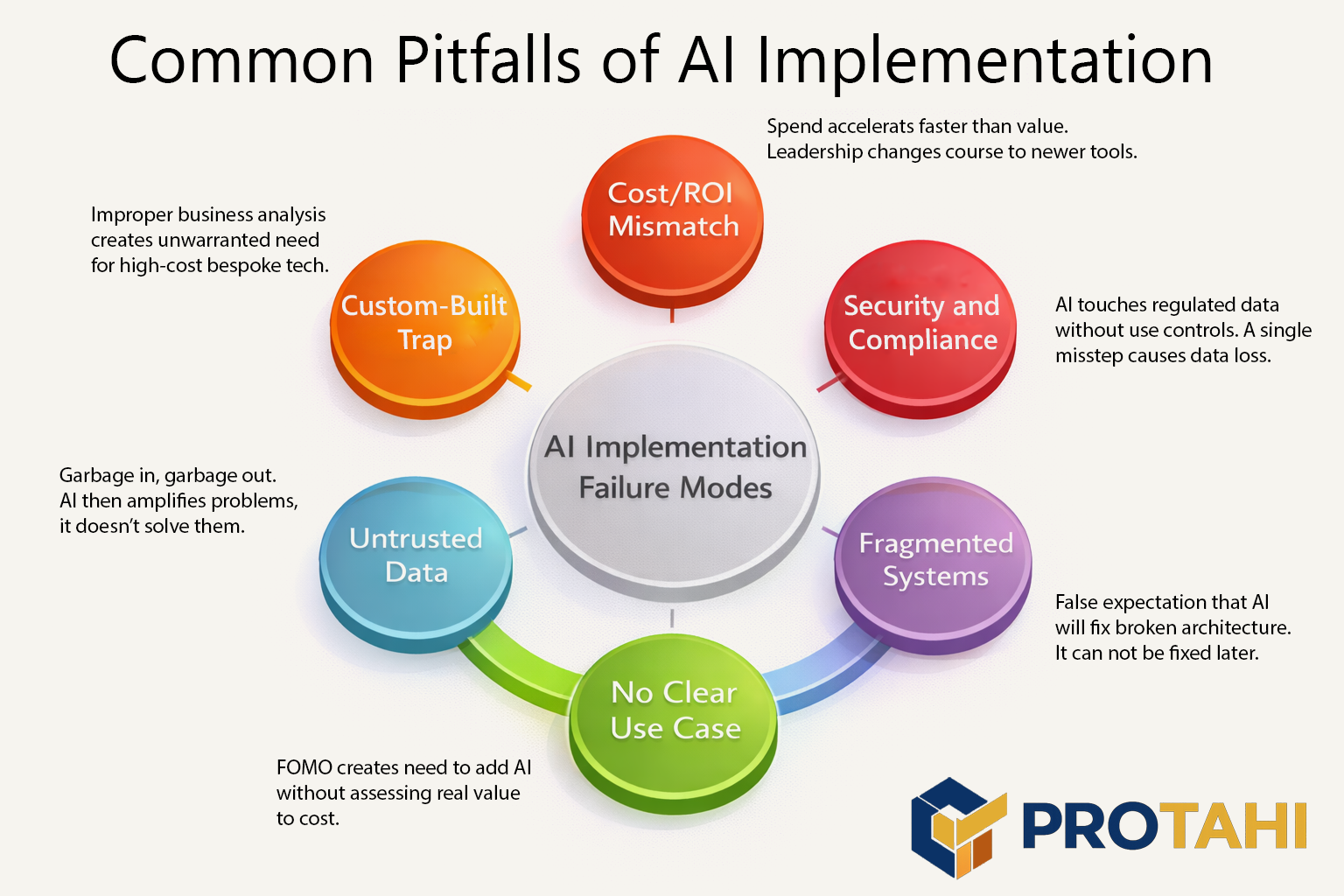
Most AI programs don’t fail because the model is weak. They fail because the work around it is theater: vague goals, pilot purgatory, and no workflow ownership. Most organisations are still experimenting and haven’t embedded AI deeply enough into workflows to get material enterprise value. (McKinsey & Company, 2025).
I bring nearly 20 years of systems implementation and service delivery leadership to AI adoption. We start with the customer problem that’s causing friction, then we design the operating model around it: data inputs, handoffs, controls, escalation, measurement. If the system doesn’t improve the customer experience or shorten time-to-resolution, it’s not “innovation”. It’s spend.
What this looks like in practice
-
Use-cases that pay for themselves. AI value comes from implementable, feasible use-cases, not wish lists. (Gartner, 2025).
-
Workflow redesign, not bolt-ons. High performers redesign workflows and put senior ownership behind adoption. (McKinsey & Company, 2025).
-
Trust and control by design. Governance, mapping, measurement, and risk management aren’t optional when AI touches customers. (NIST, 2024).
-
No hype tolerance. Gartner expects over 40% of agentic AI projects to be cancelled by 2027 due to cost and unclear value, and “agent washing” is already distorting buying decisions. (Reuters, 2025).

Edward led our move during a period of government mandated change. Part of this was designing and implementing an electronic health record using a custom Salesforce based platform. He balanced complex requirements, tight budgets, and staff support with consistent, dependable execution and levels of patience and professional insight that encouraged staff to thrive.
Make the next 30 days count.
Mission Critical Services
Mission-critical systems don’t get “pretty” points. They either hold under stress, or they fail. Emergency comms are being pushed through major transitions with more IP-based dependency, more third-party interconnect risk, more cyber exposure, and more visible outages. The teams are not just cross-functional, they span independent organizations with their own goals and mandates. Regulators are explicitly calling out persistent multi-state outage patterns and reliability gaps in modern 911 ecosystems. (Federal Register, 2025).
I’ve delivered communications technology used by emergency services, and I’ve led the kind of operations where safety is real and consequences are immediate. That changes how you design, evaluate, and run these systems, and its that change that separates what I can deliver from your average tech guru who's spent their career behind a desk. I don’t optimize for demos. I optimize for continuity, clarity, and recovery.

Image courtesy of Mineral Rangahau Joint Venture Partners
Living with the outcomes means knowing what to look for
-
Resilience by design: redundancy, diversity, and failover that aren’t optional in emergency calling and dispatch environments. (NENA, 2025).
-
Security that matches the mission: minimum security requirements and auditable controls for NG9-1-1 systems and their vendors, not “best effort” security. (NENA, 2024).
-
Operational truth: staffing, escalation paths, maintenance windows, vendor accountability, and incident runbooks that work at 3 a.m. (FCC, 2024).
-
Remote reality: backhaul fragility, power resilience, and the constraints of rural coverage. NZ is actively building nationwide public safety comms and explicitly treating resilience and remote connectivity as first-order design problems. (National Infrastructure Plan, 2024; Critical Communications Review, 2025).
Scalable Solutions
Most businesses don't need "enterprise-grade" everything, plus bloated governance processes, plus product development sprints that span years. They need systems and processes that work now, then expand without a painful rewrite when the load, team size, and customer expectations increase. The problem is, most small businesses cant afford the full-time expert when they're most useful: at the beginning of these processes. That's where fractional expertise comes in.
I design for scale by right-sizing the operating model and the tech foundation at the same time. That means standardizing what should be repeatable, keeping flexibility where it matters, and building in the hooks that let you add capability later without tearing everything apart. Standards can actually increase flexibility and reduce cost when they're used properly. (Power, 2013).
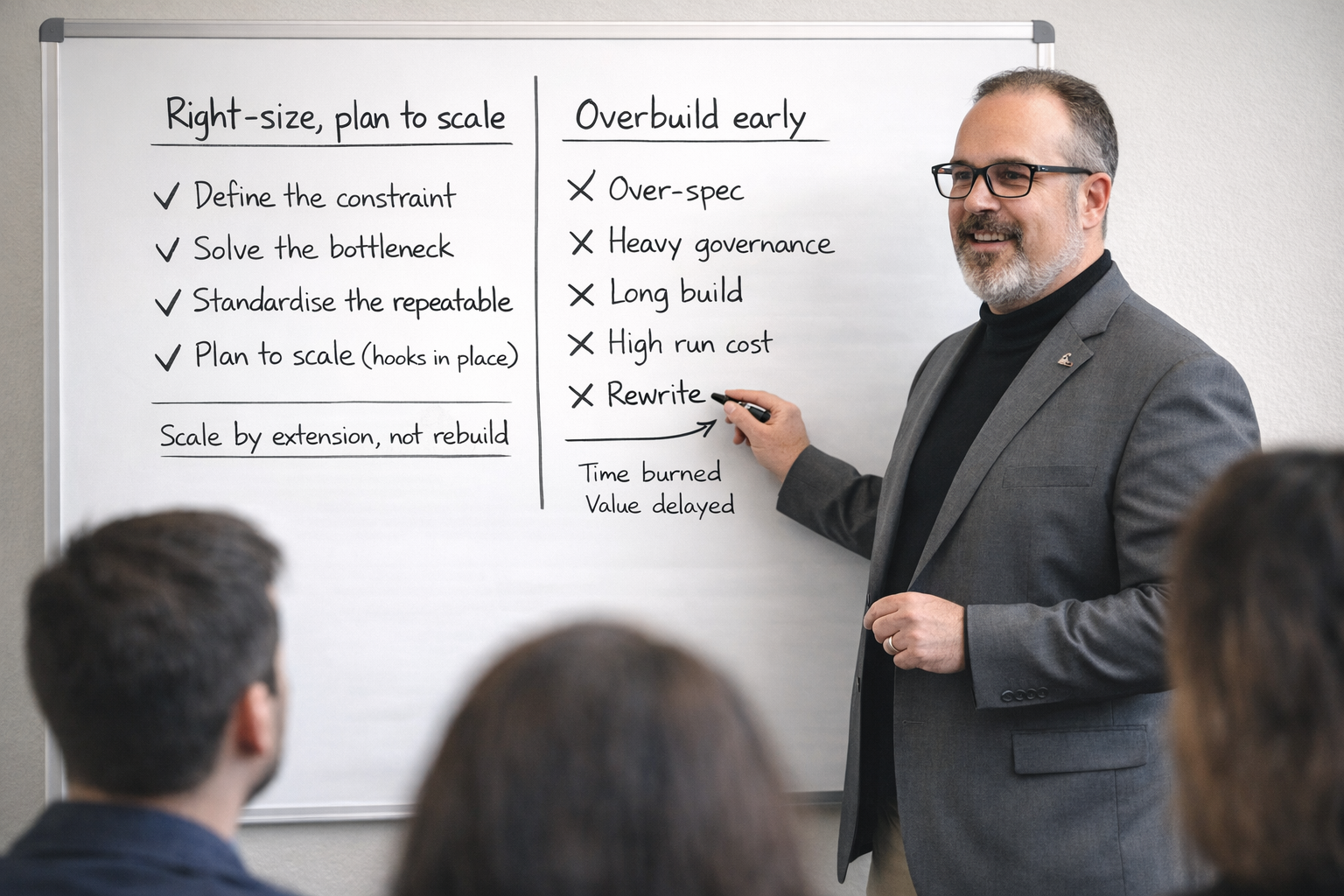
Image enhanced with AI
Cost-effective solutions that fit your business stage
-
Operating model first: cross-functional ownership is something founders and small teams know well, and large businesses try to implement. This reveals a scarcity mindset that drives efficiency early on, but in later stages needs to be revisited and worked back into the process flows (McKinsey & Company, 2024).
-
Modular design: breaks work into modules so growth doesn't automatically create bureaucracy. (Vaara, Harju, Leppälä, & Buffart, 2021).
-
Architecture tradeoffs made explicit: reliability, security, performance, and cost are designed, not hoped for. (Amazon Web Services, 2024).

Edward was a valuable asset to our organization. He combined strong technical capability in IT and service design with an effective, positive management style that consistently elevated the people around him. He was truly impressive."

COVID-19 lockdowns were keeping our normal staff out of the country. Edward stepped in and not only managed the project from start to finish, but took over logistics, site safety, and successfully negotiated our access with Crown and tribal groups. Everything was delivered on time. Outstanding.

I had a messy project and needed a technical head to sort out some conflicts in priorities. Ed stepped in and showed me where things were going sideways, using clear language. It was just what I needed.

Edward has a rare ability to connect technical work with business outcomes. He worked to keep our most demanding clients satisfied and informed. He handles pressure quietly, solves problems before they escalate, and builds confidence in the teams around him. When you work with Edward, things stay steady, even when they shouldn’t.

Working with Edward was a zero fuss experience. He was able to nagivate the complex requirements of the RMA and draw up plans for consents that were easy to read and quite clear.

I can't recommend Ed more for cross-functional leadership. His communication skills increased our customer satisfaction scores, and he cleaned up some very messy processes for us.

In less than a year, Ed had our services running with significant improvement. He helped us deliver on our service contract by balancing workload, improving support triage, and conducting site visits that enabled targeted support initiatives and training overhauls.

Edward designed predictive text systems and analytics that greatly expanded the capabilities of our systems. By identifying pain points in live operation and resolving them, he transformed a management heavy system into one with global sales potential.

Ed improves the productivity of everyone around him. He has a knack for knowing exactly how to get to the root of what's bothering a customer. He's the real deal. I'm happy to recommend him.
Still not convinced?
You're not here wasting your time reading this because you're curious. You've got a potential need, and you're seeing if there's a fit.
Let's talk about it. Schedule a short consultation with me, completely free of charge. We can chat about your challenges and where you think there might be some alignment. Any particulars can be decided upon after our chat.
Sound fair?